BUILDING NATIONS
Hendrik Hertzberg, The New Yorker, June 2003


It's tempting to suggest that the Bush Administration is failing to provide Iraq with functioning, efficient, reliable public services because it doesn't believe in functioning, efficient, reliable public services - doesn't believe that they should exist, and doesn't really believe that they can exist. The reigning ideologues in Washington - not only in the White House but also in the Republican congressional leadership, in the faction that dominates the Supreme Court, and in the conservative press and think tanks - believe in free markets, individual initiative, and private schools and private charity as substitutes for public provision. They believe that the armed individual citizen is the ultimate guarantor of public safety. They do not, at bottom, believe that society, through the mechanisms of democratic government, has a moral obligation to provide care for the sick, food for the hungry, shelter for the homeless, and education for all; and to the extent that they tolerate such activities they do so grudgingly, out of political necessity. They believe that the private sector is sovereign, and that taxes are a species of theft. To paraphrase Proudhon, les impĂ´ts, c'est le vol.


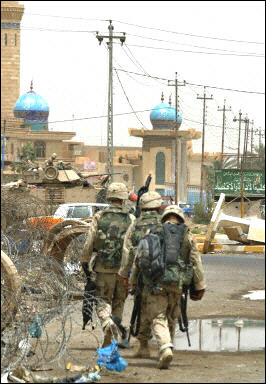
In a way, Iraq has become a theme park of conservative policy nostrums. There are no burdensome government regulations. Health and safety inspectors and environmental busybodies are nowhere to be seen. The Ministry of Finance, Iraq's equivalent of the Internal Revenue Service, is a scorched ruin. Museums and other cultural institutions, having been largely emptied of their contents, no longer have much use for public subsidies. Gun control is being kept within reasonable limits. (Although the occupying authorities are trying to discourage possession of heavy munitions, AK-47s and other assault weapons - guns of the type whose manufacture Tom DeLay and most of the House Republicans plan to re-legalize back home - have been given a pass.) And, in the absence of welfare programs and other free-lunch giveaways, faith-based initiatives are flourishing. The faith in question may be Iranian-style militant Shiism, but at least it's fundamentalist.


MORE...



the bay area


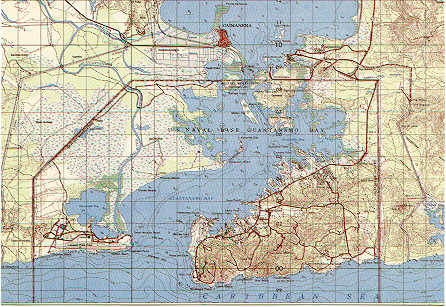
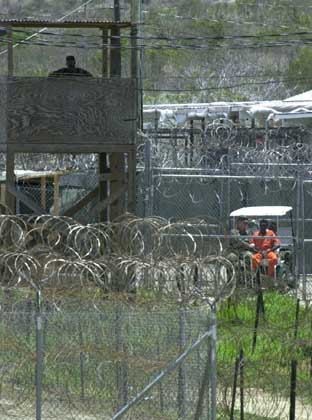
Although the bay area is not richly endowed by nature, the landscape is impressive in its own right: scores of watchtowers - both Cuban and U.S. - mark the barren land and line the miles of metal fencing that separate the base from Cuban territory. On the U.S. side lies one of the densest mine fields in the world, with an estimated 735 acres containing 70,000 antipersonnel and antitank mines. In fact, it is not unheard of for wild animals inside the base to set off the explosives.


At one point Mr. Bush turned to Ms. Swiebocka and asked, "Do people challenge the accuracy of what you present?" Mr. Fleischer, who was accompanying the president a few paces behind, said he could not hear the answer.


"US Prison Labor at Home and Abroad"
American University: Trade & Environment Database: The Mandala Project

The United States is going through a transitionary period with regards to prison labor. Greatly restricted domestically during the Great Depression, US prison labor is currently undergoing a period of liberalization. With the creation of private prisons, laws have begun to change with regards to inmate labor.


In the past two decades, the United States Department of Correctional Assistance has created, with the permission of Congress, the Prison Industries Enhancement Program (PIE). This new program has enabled prisons to combine with private firms to market products on a wider scale. Participating industries must comply with federal regulation that state that inmates must be paid the prevailing minimum wage for local similar work and receive worker's compensation. At the end of the day, about 80% of this money goes to costs for keeping the prisoner, victim restitution and help for their families.


While there are many domestic issues with the role of prison labor in the US and its effects on the national job market, many international laws also address this issue. However, according to international bodies, prison labor in the United States is perfectly legal.


There are many importers of prison made goods. Many companies use prison labor, so it is likely that most Americans have bought goods or used services provided or created by inmates. Items ranging from clothing, such as Victoria's Secret and blue jeans, and computers to services such as data entry and telemarketing are all made and performed by prison labor. As another bonus, prison made goods do not have to be labeled as such and often are appealing to companies who wish to be able to put "Made in the USA" on their products.


Companies That Use Prison Labor In the USA:


MicroJet, Nike, Lockhart Technologies, Inc., United Vision Group, Chatleff Controls, TWA, Dell Computers, Microsoft, Eddie Bauer, Planet Hollywood, Redwood Outdoors, Wilson Sporting Goods, Union Bay, Elliot Bay, A&I Manufacturing, Washington Marketing Group, Omega Pacific, J.C. Penney, Victoria's Secret, Best Western Hotels, Honda, K-Mart, Target, Kwalu, Inc., McDonald's, Hawaiian Tropical Products, Burger King, "Prison Blues" jeans line, New York, New York Hotel/Casino, Imperial Palace Hotel/Casino, Crisp Country Solid Waste Management Authority, "No Fear" Clothing Line, C.M.T. Blues, Konica, Allstate, Merrill Lynch, Shearson Lehman, Louisiana Pacific, Parke-Davis, Upjohn


MORE...