go forth and prosper

Lobbying Prohibitions Eased For Former Top Officials
5 December 2004, Dana Milbrank & Jim VandHei, Washington Post

The timing was perfect: On Nov. 23— exactly three weeks after the election and as a flurry of top Bush administration officials announced their departures— the Office of Government Ethics declared that it was relaxing prohibitions on lobbying by former Cabinet secretaries and other top officials.

Until now, senior officials at Cabinet departments and agencies had not been allowed to lobby former colleagues for a full year after leaving office— a rule designed to prevent an obvious conflict of interest. But, in a notice in the Federal Register, the ethics office issued a new rule invoking its power to declare that "a former senior employee who served in a 'parent' department or agency is not barred . . . from making communications to or appearances before any employee of any designated component of that parent."

Specifically, the Department of Homeland Security "requested that the [Ethics] Director designate seven distinct and separate components in DHS," including the Secret Service, the Coast Guard, the Transportation Security Administration, and the Emergency Preparedness and Response functions. The Justice and Treasury departments made similar requests.

These changes were so urgent that the ethics office found that "good cause exists for waiving the general requirements for notice of proposed rulemaking, opportunity for public comment and . . . a 30-day delayed effective date."

Larry Noble, executive director of the Center for Responsive Politics watchdog group, was not amused.

"It's a problem," he said, noting that the administration also expanded the "banding," or ranges, of asset values that must be reported, making it more difficult for the public to know how wealthy government officials are. "We're seeing a general loosening of ethics rules," he said.


"We think of the patient hope of men and women across the centuries who listened to the words of the profits and lived in joyful expectation."

A White House transcript of President Bush's speech at the Christmas tree lighting on Thursday. Nineteen minutes later, a corrected transcript changed "profits" to "prophets."

peaceniks, beatniks, commies and hippies

What's the origin of the word "peacenik?" Has it always been pejorative?

If it's not inclusive— or neutral— is this a word we want to keep— or throw out?

It seems to belong to another time— and perhaps should be filed away with words like "beatnik," "commie," and "hippie."

These days, referring to "peaceniks" appears to be a way to imply that you don't approve of a vast number of the people sitting to your left— and that they quite possibly don't even belong in the Democratic Party. Kevin Drum has referred to us as children.

Now that the election is more or less over— and our common goal of unseating Bush is no longer pressing— I am finding I have very little in common with many writing for the Democratic Party. We are not moving toward any "center" that I can support— the Right has moved the discussion so far into their field, any movement in that direction, now, is much too great a sacrifice of principle. *

I don't know if the Green Party could hold all of the Progressive Democrats or if we need a new party, but something has to change— the Democratic Party will soon be losing its soul.

Where can anti-war progressives of the Democratic Party meet where we will not always be shouted down or ignored? (As welcoming as Eschaton can be, there is still too much defensiveness there, and it is frustrating that there is so little discussion about nonviolent foreign policy alternatives.)

Working for peace (and justice) without resorting to military solutions is a noble endeavor. I am tired of being derided for emphasizing the possibility and its importance.

For the record, I did not support the invasion of Afghanistan— and it transpired exactly as I expected it would. I was not wrong in my opposition to a Bush-led military invasion.

There are always alternatives to dropping bombs from the air.


— glassfrequency


* beware of republicans wearing DLC suits!


evangelize THIS!

The Fundamentalist Agenda
January 2004, Davidson Loehr, UU World

excerpts:

From 1988 to 1993, the American Academy of Arts and Sciences sponsored an interdisciplinary study known as The Fundamentalism Project, the largest such study ever done. More than 100 scholars from all over the world took part, reporting on every imaginable kind of fundamentalism. And what they discovered was that the agenda of all fundamentalist movements in the world is virtually identical, regardless of religion or culture.

They identified five characteristics shared by virtually all fundamentalisms. The fundamentalists' agenda starts with insistence that their rules must be made to apply to all people, and to all areas of life. There can be no separation of church and state, or of public and private areas of life. The rigid rules of God— and they never doubt that they and only they have got these right— must become the law of the land. Pat Robertson, again, has said that just as Supreme Court justices place a hand on the Bible and swear to uphold the Constitution, so they should also place a hand on the Constitution and swear to uphold the Bible. In Khomeini's Iran, and in the recent Taliban rule of Afghanistan, we saw how brutal and bloody this looks in real time.

The second agenda item is really at the top of the list, and it's vulgarly simple: Men are on top. Men are bigger and stronger, and they rule not only through physical strength but also and more importantly through their influence on the laws and rules of the land. Men set the boundaries. Men define the norms, and men enforce them. They also define women, and they define them through narrowly conceived biological functions. Women are to be supportive wives, mothers, and homemakers.

A third item follows from the others. (Indeed each part of the fundamentalist agenda is necessarily interlocked, and needs every other part to survive.) Since there is only one right picture of the world, one right set of beliefs, and one right set of roles for men, women, and children, it is imperative that this picture and these rules be communicated precisely to the next generation. Therefore, fundamentalists must control education by controlling textbooks and teaching styles, deciding what may and may not be taught.

Fourth, fundamentalists spurn the modern, and want to return to a nostalgic vision of a golden age that never really existed. Several of the scholars observed a strong and deep resemblance between fundamentalism and fascism. Both have almost identical agendas. Men are on top, women are subservient, there is one rigid set of rules, with police and military might to enforce them, and education is tightly controlled by the state. One scholar suggested that it's helpful to understand fundamentalism as religious fascism, and fascism as political fundamentalism. The phrase “overcoming the modern” is a fascist slogan dating back to at least 1941.

The fifth point is the most abstract, though it's foundational. Fundamentalists deny history in a radical and idiosyncratic way. Fundamentalists know as well or better than anybody that culture shapes everything it touches: The times we live in color how we think, what we value, and the kind of people we become. Fundamentalists agree on the perverseness of modern American society: the air of permissiveness and narcissism, individual rights unbalanced by responsibilities, sex divorced from commitment, and so on. What they don't want to see is the way culture colored the era when their scriptures were created.

Good biblical scholarship begins by studying the cultural situation when scriptures were written in search of their original intent, so that we can better discern what messages they may still have that are relevant for our lives. But if fundamentalists were to admit that their own scriptures are as culturally conditioned as everything else, they would lose the foundation of their certainties. Some scholars see evidence that St. Paul, for instance, had severe personal hang-ups about sex that may account for his harsh teachings about homosexuality and women. Many biblical scholars treat some of Paul's teachings as rants rather than revelations. But for fundamentalists, their scriptures fell straight from heaven in a leather-bound book, every jot and tittle intact.

Except for the illustrations I've added in laying out the agenda that the Fundamentalism Project discovered, you can't tell what religion, culture, or century I'm describing. The scholars discovered this a dozen years ago while they were presenting abstracts of their papers. Several noted that all their papers were sounding alike, reporting on “species” when studying the “genus” was called for, that there were strong family resemblances between all fundamentalisms, even when the religions had had no contact, no way to influence each other.

The only way all fundamentalisms can have the same agenda is if the agenda preceded all the religions. And it did. Fundamentalist behaviors are familiar because we've all seen them so many times. These men are acting the role of “alpha males” who define the boundaries of their group's territory and the norms and behaviors that define members of their in-group. These are the behaviors of territorial species in which males are stronger than females. In biological terms, these are the characteristic behaviors of sexually dimorphous territorial animals. Males set and enforce the rules, females obey the males and raise the children; there is a clear separation between the in-group and the out-group. The in-group is protected; outsiders are expelled or fought.

. . .

What conservatives are conserving is the biological default setting of our species, which has strong family resemblances to the default setting of thousands of other species. This means that when fundamentalists say they are obeying the word of God, they have severely understated the authority for their position. The real authority behind this behavioral scheme is millions of years older than all the religions and all the gods there have ever been. It is the picture of life that gave birth to most of the gods as its projected champions.

Fundamentalism is absolutely natural, ancient, powerful— and inadequate. It's a means of structuring relationships that evolved when we lived in troops of 150 or less. But in the modern world, it's completely incapable of the nuance or flexibility needed to structure humane societies.

Fundamentalism's conservative impulse wants stability in societies. Liberal impulses serve to give us not stability but civility: humanity. They do this by expanding the definitions of our inherited territorial categories. The essential job of liberals in human societies is to enlarge our understanding of who belongs in our in-group. This is the plot of virtually all liberal advances.

Giving women the vote eighty years ago expanded the in-group from only adult males to include adult females. Once that larger definition was established by liberals, conservatives began defending that new definition of the in-group rather than the smaller one. Likewise, the civil rights movement was a way of saying that our in-group was also multi-colored. Every liberal advance adds to the list of those who belong within our society's protected group.

. . .

Maintaining both stability and civility, humane content and enduring form, in human societies is an unending dance between the conservative and the liberal impulses in human nature. The fundamentalist role in this dance is quite easy: All you have to do is cling tightly to a few simplistic teachings too small to do justice to the complex demands of the real world. You just have to cling to these, and then pretend that what you have done is honest and noble.

But the task of liberals is much, much harder. To be a liberal, to be an awake, responsive, and responsible liberal— that can take, and that can make, a whole life.

The Rev. Dr. Davidson Loehr is minister of the First Unitarian Universalist Church of Austin, Texas, and a Fellow in the Jesus Seminar. He holds degrees in theology, the philosophy of religion, and the philosophy of science. He considers himself a religious liberal but not a Unitarian Universalist.


Source:

Go to DIGBY @ HULLABALOO for commentary, links— and an action plan.

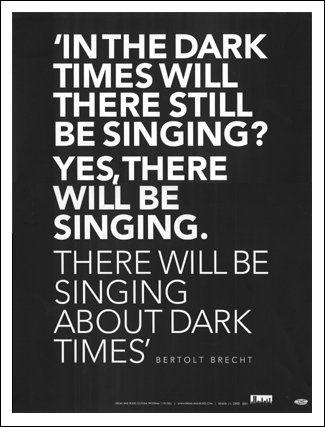
dark times

bertolt brecht

sit down, you're rockin' the boat!

Love One Another? Not on NBC or CBS
1 December 2004, John Nichols - The Online Beat, The Nation

The Rev. John Thomas, who serves as general minister and president of the United Church of Christ, is having a hard time figuring out why the same broadcasters that profited so handsomely from airing the vicious and divisive attack advertisements during the recent presidential election are now refusing to air an advertisement from his denomination that celebrates respect for one another and inclusiveness.


"It's ironic that after a political season awash in commercials based on fear and deception by both parties seen on all the major networks , an ad with a message of welcome and inclusion would be deemed too controversial," said Thomas. "What's going on here?"


The ad in question is part of an ambitious new national campaign by the UCC to appeal to Americans who feel alienated from religion and churches, and to equip the denomination's 6,000 congregations across the U.S. to welcome newcomers. In an effort to break through the commercial clutter that clogs the arteries of broadcast and cable television, the UCC ad features an arresting image: a pair of muscle-bound bouncers standing in front of a church and telling some people they can attend while turning others away.


After people of color, a disabled man and a pair of men who might be gay are turned away, the image dissolves to a text statement that: "Jesus didn't turn people away. Neither do we."


Then, as images of diverse couples and families appear on screen, an announcer explains that, "No matter who you are, or where you are on life's journey, you are welcome here."


It is a graceful commercial, which delivers an important message gently yet effectively -- something that cannot be said of most television advertising these days. But viewers of the CBS and NBC television networks won't see it because, in this age of heightened focus on so-called "moral values," quoting Jesus on the issue of inclusion is deemed to be "too controversial."


What was controversial? Apparently, the networks don't like the ad's implication that the Nazarene's welcome to all people might actually include ALL people.


Noting that the image of one woman putting her arm around another was included in the ad, CBS announced, "Because the commercial touches on the exclusion of gay couples and other minority groups by other individuals and organizations, and the fact the Executive Branch has recently proposed a Constitutional amendment to define marriage as a union between a man and a woman, this spot is unacceptable for broadcast on the (CBS and UPN) networks."


NBC was similarly concerned that the spot was "controversial." UCC leaders, pastors and congregation members are upset, and rightly so.


"It' seems incredible to me that CBS admits it is refusing to air the commercial because of something the Executive Branch, the Bush administration, is doing," says Dave Moyer, conference minister for the Wisconsin Conference of the UCC. "Since when is it unacceptable to offer a different perspective?"


Moyer says that people of all religious faiths and all ideological perspectives should be concerned that the major networks -- which dominate so much of the discourse in America -- are seeking to narrow the dialogue.


The Rev. Curt Anderson, the pastor of the First United Church of Christ in Madison, Wisconsin, says that people of good will should also be concerned about the message being sent to gays and lesbians in the aftermath of an election season that saw them targeted by the political right.


"I'm thinking of the LGBT folks in my church who felt so under attack after the election. They are getting hit again," explained the pastor. "This is another way where the culture, the media, makes them invisible. It is incredible that it is controversial for one woman to put her arm around another."


It is also bizarrely hypocritical. After all, the same NBC network that found the UCC ad "too controversial" airs programs such as "Will & Grace" that feature gay and lesbian characters. "We find it disturbing that the networks in question seem to have no problem exploiting gay persons through mindless comedies and titillating dramas, but when it comes to a church's loving welcome to committed gay couples, that's where they draw the line," explained the Rev. Bob Chase, director of the national UCC's communication ministry.


Chase has a point. CBS and NBC, networks that reap enormous profits from the public airwaves, are not serving the public interest. Rather, they are assaulting it by narrowing the dialogue and rejecting a message of inclusion that is sorely needed at this point in the American experiment.


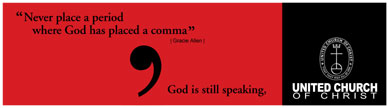
UCC

Statement from the National Council of Churches - USA
representing 36 denominations - 140,000 U.S. congregations.


related:

Michigan to strip domestic partner benefits from state workers’ contracts - due to the passage of Proposal 2, a discriminatory amendment to the state constitution that denies marriage to same-sex couples.

According to The Associated Press, Gov. Jennifer Granholm’s office will strip the domestic partner benefits for same-sex couples out of the negotiated contracts due to the passage of this amendment defining marriage as between one man and one woman and banning “similar unions for any purpose.”


Sexual orientation-based bias crime is now the second-highest category of hate crime offenses in the United States, according to new information from the FBI.

"The new statistics only offer a glimpse of the problem,” said [Human Rights Campaign President Cheryl] Jacques. "Reporting these crimes is voluntary for local jurisdictions and hate crimes often go unreported by victims due to fear and stigmatization." The data also does not track crimes based on bias against transgender people.

Norm Coleman is mad as hell...

Norm Coleman

Going After Annan - A Sordid Move by Coleman
4 December 2004, Editorial: Star Tribune, Minneapolis - St. Paul

Good old Norm; it appears there's nothing he won't do for a headline, or for his GOP masters. Minnesota's junior senator made quite a splash this week with his call for the resignation of U.N. Secretary General Kofi Annan, a splendid public servant whom the city Sen. Norm Coleman once governed has considered a semi-native son since his years at Macalester College. Even if he had never set foot in St. Paul, Annan would deserve far better than the stuff Coleman is dishing out.


The ostensible reason for seeking Annan's resignation? It was on his watch that Saddam Hussein diverted billions from the U.N.-run oil-for-food program designed to relieve the humanitarian burden on Iraqis suffering as a consequence of U.N. sanctions.


Note that no one has the slightest whiff of proof that Annan knew about, condoned or profited from this scandal. Furthermore, when the scandal surfaced, Annan appointed former Fed chairman and man of impeccable honor Paul Volcker to thoroughly investigate the matter. Volcker's report, which both he and Annan have promised will be made public, is still a work in progress.


So why is Coleman so exercised, aside from the prospect of juicy publicity? Well, he says, Annan isn't cooperating very well with Coleman's Senate subcommittee, which also seeks to investigate the matter. The United Nations hasn't provided documents the subcommittee needs.


The sanctions were imposed by the U.N. Security Council, the food-for-oil program was initiated by the Security Council, and Annan works for the Security Council. He does not work for the U.S. Senate. Moreover, Volcker has told the Senate subcommittee that it can have the documents it seeks once he is finished with them -- most likely next month. That seems about right.


Readers also should know that this isn't a new issue, and it has very little to do with the oil-for-food program. For months before the election, the right-wing constellation of blogs and talk radio was alive with incendiary rhetoric about Annan and the oil-for-food scandal, not to mention accusations that the mainstream media were soft-peddling it to protect Annan. This is really all about Annan's refusal to toe the Bush line on Iraq and the administration's generally unilateral approach to foreign affairs. The right-wingers hate Annan and saw in the food-for-oil program a possible chink in his armor. They went after it with a venomous fury. Coleman seems only too eager to aid their cause.


Numerous Star Tribune readers have pointed out -- appropriately, in our view -- that if Coleman wants to investigate scandal, he need not go as far afield as the United Nations. He could start with those really nice contracts that Vice President Dick Cheney's former firm, Halliburton, got in Iraq. He could move on to the abuses at Abu Ghraib and Guantanamo. Just this week, for instance, came accusations from the International Red Cross that treatment of prisoners in Guantanamo amounted to torture. Then the Washington Post reported a secret memo from a Pentagon investigator, written before the Abu Ghraib scandal hit the front pages, that warned the brass of widespread abuses. What brass has been held accountable?


There is so much from the last four years that Coleman could find to keep himself busy. Just about every aspect of the Iraq misadventure smells to the high heavens. But of course investigating those things would be unpleasant for those Coleman so fawningly seeks to please.

What an embarrassment.


Salon.com: You write with great love about your native state and its traditions of Scandinavian decency. But Minnesota also elected Norm Coleman-- what went wrong?

Garrison Keillor: Norm Coleman is a man without a single principled bone in his body. He was a liberal Democrat who saw greater career opportunities on the other side and one night he sewed himself a new set of beliefs and crossed over. He is the first truly cynical politician in Minnesota in my lifetime. What went wrong? Sen. Paul Wellstone's plane crashed in the woods.


Norm Coleman- then & now


see also Liberal Oasis

Guiliani's Chauffeur to Protect America

from Nick Confessore at TAPPED:

Let's clear up a few things. First, Kerik has never had a high-level post in Washington before, and so will be at the mercy of all the more Washington-savvy subordinates who are, at this moment, fighting to retain their institutional prerogatives and stymie major reform within the recently-created Department of Homeland Security. That's a problem considering that DHS remains a cobbled-together assemblage of legacy agencies with little coordination or clear direction.

Second, nobody can seriously credit Kerik for a significant portion of New York's decline in crime. He was police commissioner for just over a year, August 2000 until a few months after 9-11, and from what I know not an especially good one. The Washington Post even quotes a former colleague saying that Kerik is in fact a bad manager. Further evidence of this comes from point number three: His last big job was to spend six months training the Iraqi police force. He came back here after three months for reasons left obscure to the public, but easy to discern nonetheless: The training of Iraq's police has been a disaster.


HOMELAND SECURITY, R.I.P.?


Questions for Kerik - Is he qualified to run the Department of Homeland Security?
3 December 2004, Fred Kaplan, Slate


Stop me Before I Quit Again!
3 December 2004, Benjamin Wallace-Wells, Political Animal

Speaking Truth to Nicholas Kristof

Guest poster, Donald Johnson at Body & Soul writes:

I'm antiwar, but I recognize that the world is a complicated, messy, morally gray place, where it's not always clear what the best course of action is going to be if you want to save the largest number of lives.  So I don't know if the withdrawal option is right. Iraq might plunge into worse chaos -- something withdrawal advocates should think about before being too judgmental of the motives of the military intervention types.  But if Kristof favors the US going around using the military in an alleged effort to do good, the very least he can do is to insist that when war crimes are committed as a result of policy decisions, then high-ranking American officials (not just sergeants and lieutenants) should face long prison terms. That would provide strong incentives for political and military leaders to plan carefully and really think things through before they start dropping bombs on cities  and favoring torture. It would also firmly impress on the world that we really mean what we say.


As it happens, I don't think we mean what we say and don't expect to see anything of the sort done and don't for one second think that the Bush Administration really cares about humanitarian issues in any serious way, but Kristof is probably serious and if so, then he ought to point it out when we commit war crimes. The use of aerial bombing as a form of collective punishment, or to drive wedges between civilians and insurgents, is a war crime.  So is torture.  So is the targeting of civilian infrastructure necessary for public health, whether done by insurgents in 2003-2004 or Americans in 1991. And invading a country under false pretenses is criminal. Taking the most benign interpretation possible, dropping bombs on cities seems like a dumb way to win hearts and minds.  So why doesn't he say something about this?

Speaking half-truth to the powerless