
State Secrets
Doug Ireland writes:
Sunday's New York Times lead front-page story out of Washington is headlined "Rule Change Lets CIA Freely Send Suspects Abroad." It's nice to see the Times finally catching up to the story that the Bush administration has been routinely sending people accused of terrorism to despotic allies of Washington, countries in which physical torture is commonplace and will be visited on those suspected terrorists (although the word "torture" only made it into the subhead in the Times story, not the main headline). A significant number of other major news outlets-- from the WashPost to the Guardian, not to mention the major European dailies and the BBC-- have been reporting this story for months. The San Francisco Chronicle wrote about it a year ago. So did my friend Tom Engelhardt, in a particularly tough and prescient piece. However, better late than never, I suppose, where the arteriosclerotic Times is concerned.
But the Times and its reporters, Doug Jehl and David Johnston, missed a hugely significant aspect of this story that strikes at the very heart of our democracy-- a story which luckily can be found on the front page of the Sunday Baltimore Sun.
Says the Sun::
• "The Bush administration is aggressively wielding a rarely used executive power known as the state-secrets privilege in an attempt to squash hard-hitting court challenges to its anti-terrorism campaign....
• "The government is invoking the privilege in an attempt to wipe out the heart of a lawsuit that seeks to examine rendition, the secretive and controversial practice of sending terrorism suspects to foreign countries where they might be tortured..."
• "Use of the secrets privilege could also eliminate a suit by a former FBI contract linguist who charges that the bureau bungled translations of terrorism intelligence before and after the Sept. 11 attacks..."
• "The secrets privilege is an especially powerful weapon because federal judges, reluctant to challenge the executive branch on national security, almost never refuse the government's claim to confidentiality."
• "That is true even though a growing body of declassified documents suggests that in the past, at least, the privilege has been used to protect presidential power, not national secrets, according to Thomas Blanton, director of the National Security Archive at George Washington University, which works to expand public access to government documents..."
There's a lot more to this enormously significant story.
More: N.Y. Times has a really bad day on torture, the Constitution, & Pentagon mendacity


Red State Values
Rule Change Lets C.I.A. Freely Send Suspects Abroad to Jails
6 March 2005, Douglas Jehl & David Johnston, New York Times
WASHINGTON - The Bush administration's secret program to transfer suspected terrorists to foreign countries for interrogation has been carried out by the Central Intelligence Agency under broad authority that has allowed it to act without case-by-case approval from the White House or the State or Justice Departments, according to current and former government officials.
The unusually expansive authority for the C.I.A. to operate independently was provided by the White House under a still-classified directive signed by President Bush within days of the Sept. 11, 2001, attacks at the World Trade Center and the Pentagon, the officials said.
The process, known as rendition, has been central in the government's efforts to disrupt terrorism, but has been bitterly criticized by human rights groups on grounds that the practice has violated the Bush administration's public pledge to provide safeguards against torture.
In providing a detailed description of the program, a senior United States official said that it had been aimed only at those suspected of knowing about terrorist operations, and emphasized that the C.I.A. had gone to great lengths to ensure that they were detained under humane conditions and not tortured.
The official would not discuss any legal directive under which the agency operated, but said that the "C.I.A. has existing authorities to lawfully conduct these operations."
The official declined to be named but agreed to discuss the program to rebut the assertions that the United States used the program to secretly send people to other countries for the purpose of torture. The transfers were portrayed as an alternative to what American officials have said is the costly, manpower-intensive process of housing them in the United States or in American-run facilities in other countries.
In recent weeks, several former detainees have described being subjected to coercive interrogation techniques and brutal treatment during months spent in detention under the program in Egypt and other countries. The official would not discuss specific cases, but did not dispute that there had been instances in which prisoners were mistreated. The official said none had died.
The official said the C.I.A.'s inspector general was reviewing the rendition program as one of at least a half-dozen inquiries within the agency of possible misconduct involving the detention, interrogation and rendition of suspected terrorists.
In public, the Bush administration has refused to confirm that the rendition program exists, saying only in response to questions about it that the United States did not hand over people to face torture. The official refused to say how many prisoners had been transferred as part of the program. But former government officials say that since the Sept. 11 attacks, the C.I.A. has flown 100 to 150 suspected terrorists from one foreign country to another, including to Egypt, Syria, Saudi Arabia, Jordan and Pakistan.
Each of those countries has been identified by the State Department as habitually using torture in its prisons. But the official said that guidelines enforced within the C.I.A. require that no transfer take place before the receiving country provides assurances that the prisoner will be treated humanely, and that United States personnel are assigned to monitor compliance.
"We get assurances, we check on those assurances, and we double-check on these assurances to make sure that people are being handled properly in respect to human rights," the official said. The official said that compliance had been "very high" but added, "Nothing is 100 percent unless we're sitting there staring at them 24 hours a day."
It has long been known that the C.I.A. has held a small group of high-ranking leaders of Al Qaeda in secret sites overseas, and that the United States military continues to detain hundreds of suspected terrorists at Guantánamo Bay, Cuba, and in Afghanistan. The rendition program was intended to augment those operations, according to former government officials, by allowing the United States to gain intelligence from the interrogations of the prisoners, most of whom were sent to their countries of birth or citizenship.
Before Sept. 11, the C.I.A. had been authorized by presidential directives to carry out renditions, but under much more restrictive rules. In most instances in the past, the transfers of individual prisoners required review and approval by interagency groups led by the White House, and were usually authorized to bring prisoners to the United States or to other countries to face criminal charges.
As part of its broad new latitude, current and former government officials say, the C.I.A. has been authorized to transfer prisoners to other countries solely for the purpose of detention and interrogation.
The covert transfers by the C.I.A. have faced sharp criticism, in part because of the accounts provided by former prisoners who say they were beaten, shackled, humiliated, subjected to electric shocks, and otherwise mistreated during their long detention in foreign prisons before being released without being charged. Those accounts include cases like the following:
• Maher Arar, a Syrian-born Canadian, who was detained at Kennedy Airport two weeks after the Sept. 11 attacks and transported to Syria, where he said he was subjected to beatings. A year later he was released without being charged with any crime.
• Khaled el-Masri, a Lebanese-born German who was pulled from a bus on the Serbia-Macedonia border in December 2003 and flown to Afghanistan, where he said he was beaten and drugged. He was released five months later without being charged with a crime.
• Mamdouh Habib, an Egyptian-born Australian who was arrested in Pakistan several weeks after the 2001 attacks. He was moved to Egypt, Afghanistan and finally Guantánamo. During his detention, Mr. Habib said he was beaten, humiliated and subjected to electric shocks. He was released after 40 months without being charged.
In the most explicit statement of the administration's policies, Alberto R. Gonzales, then the White House counsel, said in written Congressional testimony in January that "the policy of the United States is not to transfer individuals to countries where we believe they likely will be tortured, whether those individuals are being transferred from inside or outside the United States." Mr. Gonzales said then that he was "not aware of anyone in the executive branch authorizing any transfer of a detainee in violation of that policy."
Administration officials have said that approach is consistent with American obligations under the Convention Against Torture, the international agreement that bars signatories from engaging in extreme interrogation techniques. But in interviews, a half-dozen current and former government officials said they believed that, in practice, the administration's approach may have involved turning a blind eye to torture. One former senior government official who was assured that no one was being mistreated said that accumulation of abuse accounts was disturbing. "I really wonder what they were doing, and I am no longer sure what I believe," said the official, who was briefed periodically about the rendition program.
In Congressional testimony last month, the director of central intelligence, Porter J. Goss, acknowledged that the United States had only a limited capacity to enforce promises that detainees would be treated humanely. "We have a responsibility of trying to ensure that they are properly treated, and we try and do the best we can to guarantee that," Mr. Goss said of the prisoners that the United States had transferred to the custody of other countries. "But of course once they're out of our control, there's only so much we can do. But we do have an accountability program for those situations."
The practice of transporting a prisoner from one country to another, without formal extradition proceedings, has been used by the government for years. George J. Tenet, the former director of central intelligence, has testified that there were 70 cases before the Sept. 11 attacks, authorized by the White House. About 20 of those cases involved people brought to the United States to stand trial under informal arrangements with the country in which the suspects were captured.
Since Sept. 11, however, it has been used much more widely and has had more expansive guidelines, because of the broad authorizations that the White House has granted to the C.I.A. under legal opinions and a series of amendments to Presidential Decision Directives that remain classified. The officials said that most of the people subject to rendition were regarded by counterterrorism experts as less significant than people held under direct American control, including the estimated three dozen high ranking operatives of Al Qaeda who are confined at secret sites around the world.
The Pentagon has also transferred some prisoners to foreign custody, handing over 62 prisoners to Pakistan, Morocco, Saudi Arabia and Kuwait, among other countries, from the American prison in Guantánamo Bay, in actions that it has publicly acknowledged. In some of those cases, a senior Defense Department official said in an interview on Friday, the transfers were for the purpose of prosecution and trials, but others were intended solely for the purpose of detention. Those four countries, as well Egypt, Jordan and Syria, were among those identified in a State Department human rights report released last week as practicing torture in their prisons.
In an interview, the senior official defended renditions as one among several important tools in counterterrorism efforts. "The intelligence obtained by those rendered, detained and interrogated have disrupted terrorist operations," the official said. "It has saved lives in the United States and abroad, and it has resulted in the capture of other terrorists."
see also:
Newsweek - Aboard Air CIA
Hunter @ Daily Kos - Operation See No Evil
Jeanne @ Body & Soul - Panic
CBS News: 60 minutes - CIA Flying Suspects To Torture?
Bob Herbert: NYT - It's Called Torture
John Crewdson: Chicago Tribune - Italy probes possible CIA role in abduction
death by sonar
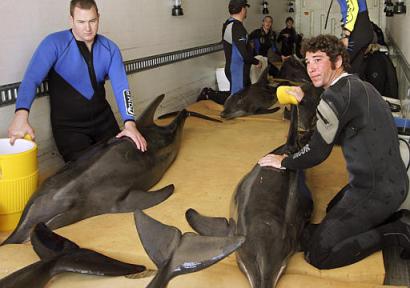
Dolphin Beaching Came After Sub Exercise
6 March 2005, AP
KEY WEST, Fla. - The Navy and marine wildlife experts are investigating whether the beaching of dozens of dolphins in the Florida Keys followed the use of sonar by a submarine on a training exercise off the coast.
More than 20 rough-toothed dolphins have died since Wednesday's beaching by about 70 of the marine mammals, Florida Keys National Marine Sanctuary spokeswoman Cheva Heck said Saturday.
A day before the dolphins swam ashore, the USS Philadelphia had conducted exercises with Navy SEALs off Key West, about 45 miles from Marathon, where the dolphins became stranded.
Navy officials refused to say if the submarine, based at Groton, Conn., used its sonar during the exercise.
Some scientists surmise that loud bursts of sonar, which can be heard for miles in the water, may disorient or scare marine mammals, causing them to surface too quickly and suffer the equivalent of what divers know as the bends— when sudden decompression forms nitrogen bubbles in tissue.
"This is absolutely high priority," said Lt. Cdr. Jensin Sommer, spokeswoman for Norfolk, Va.-based Naval Submarine Forces. "We are looking into this. We want to be good stewards of the environment, and any time there are strandings of marine mammals, we look into the operations and locations of any ships that might have been operating in that area."
Experts are conducting necropsies on the dead dolphins, looking for signs of trauma that could have been inflicted by loud noises.
via: Left I on the News
death by laser
Maximum pain is aim of new US weapon
2 March 2005, David Hambling, New Scientist
The US military is funding development of a weapon that delivers a bout of excruciating pain from up to 2 kilometres away. Intended for use against rioters, it is meant to leave victims unharmed. But pain researchers are furious that work aimed at controlling pain has been used to develop a weapon. And they fear that the technology will be used for torture.
"I am deeply concerned about the ethical aspects of this research," says Andrew Rice, a consultant in pain medicine at Chelsea and Westminster Hospital in London, UK. "Even if the use of temporary severe pain can be justified as a restraining measure, which I do not believe it can, the long-term physical and psychological effects are unknown."
The research came to light in documents unearthed by the Sunshine Project, an organisation based in Texas and in Hamburg, Germany, that exposes biological weapons research. The papers were released under the US's Freedom of Information Act.
One document, a research contract between the Office of Naval Research and the University of Florida in Gainesville, US, is entitled "Sensory consequences of electromagnetic pulses emitted by laser induced plasmas".
It concerns so-called Pulsed Energy Projectiles (PEPs), which fire a laser pulse that generates a burst of expanding plasma when it hits something solid, like a person (New Scientist print edition, 12 October 2002). The weapon, destined for use in 2007, could literally knock rioters off their feet.
Pain trigger
According to a 2003 review of non-lethal weapons by the US Naval Studies Board, which advises the navy and marine corps, PEPs produced "pain and temporary paralysis" in tests on animals. This appears to be the result of an electromagnetic pulse produced by the expanding plasma which triggers impulses in nerve cells.
The new study, which runs until July and will be carried out with researchers at the University of Central Florida in Orlando, aims to optimise this effect. The idea is to work out how to generate a pulse which triggers pain neurons without damaging tissue.
The contract, heavily censored before release, asks researchers to look for "optimal pulse parameters to evoke peak nociceptor activation" - in other words, cause the maximum pain possible. Studies on cells grown in the lab will identify how much pain can be inflicted on someone before causing injury or death.
Long-term risk
New Scientist contacted two researchers working on the project. Martin Richardson, a laser expert at the University of Central Florida, US, refused to comment. Brian Cooper, an expert in dental pain at the University of Florida, distanced himself from the work, saying "I don't have anything interesting to convey. I was just providing some background for the group." His name appears on a public list of the university's research projects next to the $500,000-plus grant.
John Wood of University College London, UK, an expert in how the brain perceives pain, says the researchers involved in the project should face censure. "It could be used for torture," he says, "the [researchers] must be aware of this."
Amanda Williams, a clinical psychologist at University College London, fears that victims risk long-term harm. "Persistent pain can result from a range of supposedly non-destructive stimuli which nevertheless change the functioning of the nervous system," she says. She is concerned that studies of cultured cells will fall short of demonstrating a safe level for a plasma burst. "They cannot tell us about the pain and psychological consequences of such a painful experience."
UPDATE: BoingBoing points to a copy of this government contract at The Memory Hole-- in which both the Pulsed Energy Projectile (PEP) and the Active Denial System (ADS) are linked to pain studies at the University of Florida.
death by "microwave"

1 June 2004, Greg Gordon, The Sacramento Bee
WASHINGTON - Test subjects can't see the invisible beam from the Pentagon's new, Star Trek-like weapon, but no one has withstood the pain it produces for more than three seconds.
People who volunteered to stand in front of the directed energy beam say they felt as if they were on fire. When they stepped aside, the pain disappeared instantly.
The long-range column of millimeter-wave energy is known as the "Active Denial System" for its ability to prevent an aggressor from advancing. Senior military officials, who plan to deliver the device for troop evaluation this fall, say years of testing has produced no sign it will lead to health effects beyond perhaps causing skin to temporarily redden.
It is among the most potent of a new generation of futuristic, "less-than-lethal" weapons being developed by the Defense Department - tools that could dramatically alter the way police control riots and soldiers fight wars.
Other nonlethal devices undergoing tests include "superlubricants" that could make a road or runway too slippery for car or airplane tires to gain traction; directed sound waves to drive people away from an area; and nets able to stop cars.
Marine Col. David Karcher, who heads the Pentagon's Joint Non-Lethal Weapons Directorate, says the energy beam is aimed at helping troops and police in confusing situations by offering options "between bullets and a bullhorn."
Marine Capt. Dan McSweeney, a spokesman for the Non-Lethal Weapons Directorate, pointed to "instances in Iraq where crowd situations have unfortunately ended in violence" and death.
Karcher and other military officials are trying to alleviate fears that the device might be misused to harm civilians or converted into a torture machine that leaves no marks.
In an attempt to anticipate how the world would greet the new weapon, the Air Force this month asked social science graduate students at the University of Minnesota and other colleges for help.
Researchers were offered $12,000 to spend the summer reviewing literature and assessing how Americans and other cultures might react to its use.
In the solicitation, Maj. Jonathan Drummond of the Air Force's Directed Energy Bioeffects Division noted that the Active Denial System could provide U.S. forces "with a nonlethal capability in military operations other than war." Among possible uses, he listed peacekeeping, humanitarian operations and crowd control.
Introduction of such a device in either noncombat or wartime situations could raise thorny questions: Would it be acceptable to inflict so much pain on unruly protesters? How would such a weapon be viewed if used on crowds in Third World countries? Would it violate international humanitarian principles if used in battle? Might it be used secretly during interrogations to torture suspected terrorists into cooperating?
Karcher said the Active Denial System "is absolutely not designed or intended or built" to be a torture device.
"To use this as any sort of torture device would be in direct violation of" the Pentagon's definition of nonlethal weapons, he said. "Nor, as professionals, would any of us sign up for it."
But in an era of secret interrogations of al-Qaida suspects and revelations of U.S. abuse of prisoners at Iraq's Abu Ghraib prison, Executive Director Doug Johnson of the Minneapolis-based Center for Torture Victims is skeptical.
"It seems fundamentally a weapon that's designed to create a great deal of pain and fear," Johnson said. "The concern I would have is ... once this kind of technology is available and there's a perception that it's safe and nonlethal, it seems like a natural device to be used in interrogations.
"Is it torture if it only creates a sensation of pain, but leaves no marks and no long-term damage? I would say yes. Torture is primarily a psychological device, and finding different ways to use the body against the mind has been the struggle of torture technologies for thousands of years."
He said "human history would demonstrate" that once a potential torture technology is available, it usually is put into action.
Karcher and other military officials stressed that the device has received interim approvals from international treaty conventions, has twice passed Pentagon legal reviews and will be subject to clear rules of engagement.
Eleven years in the making at a cost of more than $50 million, the Active Denial System is still years from deployment. It weighs about 4 tons and consists largely of a big dish and antenna that are mounted on a Humvee multipurpose vehicle.
But researchers are hoping to miniaturize it, Karcher said. Air Force officials want to work with the prime contractor, the Raytheon Corp., to design a version that could be mounted on a military transport plane so its beam could cut a broader swath on a battlefield.
Once an operator has aimed the antenna using a scope, the press of a button sends out a column of millimeter-wave, electromagnetic energy at the speed of light. Pentagon officials say that the weapon's exact reach and its column size are classified, but that it can extend beyond the 550-meter effective range of bullets. Its intensity is the same at any distance.
Susan Levine, the Pentagon's project manager for the energy beam, said years of tests on humans and animals enabled researchers to establish a margin of safety. After several seconds, the device automatically shuts off to avoid burning its target, she said.
When the beam hits an individual, it penetrates 1/64th of an inch beneath the skin and heats water molecules to 130 degrees in less than a second.
"It tricks the pain sensors into thinking they're on fire," said Rich Garcia, a spokesman for the Air Force Research Laboratory at Kirtland Air Force Base in Albuquerque, N.M.
Garcia knows firsthand. He was among hundreds of test volunteers, standing in a doorway with his back facing the device.
"They did a full body back shot," he said. "It hit in the small of my back first. For the first millisecond, it just felt like the skin was warming up. Then it got warmer and warmer and you felt like it was on fire."
He said he lunged out of the doorway.
"As soon as you're away from that beam your skin returns to normal and there is no pain," Garcia said. "I thought to myself, 'Why you wimp. You know it's not causing any damage. You'll be able to override it.' Each of the next three times, I was on there a little bit longer.
"The fourth one was the longest. It was about two seconds. It felt like my hair was on fire."
The beam easily penetrates clothing, he said, because clothes are porous, though a thin suit of armor would block it.
UPDATE: BoingBoing points to a copy of this government contract at The Memory Hole-- in which both the Pulsed Energy Projectile (PEP) and the Active Denial System (ADS) are linked to pain studies at the University of Florida.
"folks, we have got a problem"
"I like doing this, by the way-- I like going around the country saying, Folks, we have got a problem."
- George II
digby writes:
I still maintain that whenever somebody says that we must present an alternative, we should say:
We have presented the alternative. It's called 'Social Security'. It works very, very well and Democrats are damned proud to have created it.
I also think it might be useful for Democrats to say:
The president likes to say that he enjoys going around the country and saying 'Folks, we have got a problem.' But this problem, if it even is a problem, won't become evident for another 40 years. Meanwhile we've got a lot of problems right now in this country that the president doesn't want to talk about...


sultans of swing

28 February 2005, Bernhard Zand, Der Spiegel
"The countries lining the Persian Gulf in the Middle East are filthy rich and relatively free of Islamist fundamentalism. And it's not just oil. Gigantic building projects mostly geared toward the tourism industry are becoming the region's-- and particularly Dubai's-- forte. And terrorism is so far leaving the region alone."
_ _ _ _ _
"The capitalist pulse of the Arab world now beats in the small Gulf states. The UAE is quickly developing into a sort of Persian Gulf Asian Tiger-- especially in the banking and service industries. The Kingdom of Qatar, long decried as the dreariest of Arab countries, now hosts the Al-Jazeera network, which has given the approximately 300 million Arabs in the region their first taste of diversity of opinion and also the sense of being truly one nation. The Kingdom of Bahrain, in addition to having brought the first Formula 1 Grand Prix to the region, has, like nearby Kuwait, an elected parliament that's often the scene of lively debates. The Sultanate of Oman is also gradually emerging from the shadows and slowly transforming itself into a dream destination for tourists.
But for some reason, the Muslim countries of Northern Africa and the Arab countries like Syria, Egypt and Saudi Arabia-- with their petrified social structures and generally aging leaders-- have remained behind..."
article: Emirates See Fortunes Rise
simmering
1 March 2005, Annette Grossbongardt, Der Spiegel
Mirit Danon is not likely to forget the evening of Nov. 4, 1995. On that fateful autumn day a decade ago, a Jewish religious fanatic gunned down Israel's then-prime minister, Yitzhak Rabin. Danon was his secretary at the time. She also still clearly remembers the weeks leading up to the assassination. It was, after all, her phone that received the myriad threatening phone calls made against Rabin. "You son of a bitch!" they would scream into her ear. "Traitor! Death awaits you!"
Now, 10 years later, it seems to Danon that history is repeating itself. She still sits at the same desk just outside of the prime minister's office. This time, however, it is her new boss, Prime Minister Ariel Sharon, who is the target for the murderous threats. The reason? In the face of fierce opposition from the right, he is planning on removing the Israeli settlements from the Gaza Strip this summer. "Sharon is Hitler's partner," reads the graffiti on the sides of buildings in Jerusalem. "Rabin is waiting for you!"
When Sharon showed her some of the most recent threat letters, the normally discreet secretary decided to go public. "We have to get people to wake up," she told the daily paper Maariv. "I have the feeling that I am sitting in the same cinema and watching the same horror film."
Her impression is likely not far from the truth. Since the Israeli cabinet on Feb. 20 officially decided to go ahead with the evacuation of 7,000 settlers from the Gaza Strip and a further 1,000 from the West Bank, the country has been readying itself for what may turn out to be one of the most intense internal struggles since the founding of Israel in the late 1940s. Those supporting Sharon's plan stand eyeball to eyeball with the settlers. Peaceful democrats oppose the religious zealots. Jews are pitted against Jews. The officials in charge of the evacuation are being referred to as the "Judenrat"-- a reference to the Jewish administrators who were forced to work with the government in Nazi Germany to help resettle Jews into ghettos. Additionally, a number of Sharon's ministers have, like Sharon himself, received death threats.
One of Sharon's close associates recently even went so far as to say, "I have the feeling that we are on the eve of a civil war."
- - - - -
The conservative Likud rebels who are opposing the withdrawal-- the most prominent among them is Sharon's rival and former prime minister Benjamin Netanyahu-- are demanding a referendum on the issue. Between 30 and 40 Likud parliamentarians have already signed a corresponding petition. "Sharon was elected on the opposite mandate-- that the settlements in Gaza Strip are just as important as Tel Aviv," criticized rebel leader Uzi Landau.
But few believe they actually have a chance of holding a referendum on the settlement evacuations. The last hope for Sharon's opponents is the upcoming vote on the Israeli budget, which is expected to happen by the end of March at the latest. If the prime minister is unable to secure a majority, his government will fall.
Meanwhile, the settlers-- like the government-- are preparing for the worst. One group operating under the name "Last Judgement" has created a paramilitary organization under the command of a retired Israeli military general that even has its own war staff. As many as 100,000 supporters are said to be ready to fight on behalf of the threatened Gaza settlers-- they say they will use their bodies to block the police from coming.
"We're going to call for civil disobedience, but we're against violence," said settler leader Pinchas Wallerstein. But can the resistance remain free of violence? In the Gaza Strip alone, around 3,000 settlers possess weapons.
But the greatest danger is less likely to come from the settlers-- the majority of whom are assumed to be peaceful citizens-- than from right-wing extremists. A fanatical loner is the nightmare of the Israeli intelligence services. "The next killer lives among us," warned the tabloid Maariv. "He doesn't attract attention, he speaks in moderate tones, he's anonymous, silent and deadly. He's just waiting for the right moment and it will come soon."
MORE: Will Sharon's Settlement Plan Spark a Fratricidal War?
"only one witness has come forward"
Anti-Hate Crime Rally Draws More Than 500
2 March 2005, NBC-17-Raleigh
CHAPEL HILL, N.C. -- A gay college student who was taunted and beaten in Chapel Hill broke his silence Tuesday night in an interview with NBC 17.
Thomas Stockwell, 21, came forward after a rally and march against hate crime that drew hundreds to the campus of the University of North Carolina.
Stockwell said six men attacked him Friday night on Franklin Street at about 2 a.m.
"Out of nowhere I just hear 'Fag' and all sorts of derogatory comments made towards me," Stockwell said. "At first I didn't realize they were yelling at me."
The six men, all about 20, chased Stockwell down, then broke his nose and knocked him out.
"They just punched me in the face," Stockwell recalled. "I did fight back. I'm not the only one hurting in town tonight."
Stockwell was on the phone with some friends when the beating took place.
"I heard his phone drop and then heard him yell," one friend told NBC 17. "A couple minutes later some girl came on the phone and said 'If you're this guy's friend, come get him quickly.'"
More than 500 attended the rally and march organized by UNC-Chapel Hill's Gay, Lesbian, Bisexual, Transgender and Straight Alliance. Several delivered speeches, including Chapel Hill town councilman Mark Kleinschmidt, whose boyfriend is the mayor of Carrboro.
"When I leave for dinner with my boyfriend, I think twice before I reach across the table and hold his hand -- even though I live in Chapel Hill" Kleinschmidt told the crowd.
The rally began at the student center and ended with a march from the school's campus to Franklin Street.
"We're not the same people we were before," Stockwell said. "We're more organized and we're fighting back."
They are fighting back in two ways. One, pushing legislatures to change hate crime legislation to include gays.
Another is asking people who witnessed Stockwell's beating to come forward. His friend told NBC 17 there was a crowd of people standing on the street when Stockwell was attacked.
So far, only one witness has come forward.
"if the men are convicted"
3 Arrested In Alleged Gay Beating
1 March 2005, KOAT-7- Albuquerque
SANTA FE, N.M. --A man remained hospitalized in intensive care Tuesday morning after he and another man were beaten in what Santa Fe police said was a hate crime sparked because the men are gay.
According to a report in Tuesday's edition of the Albuquerque Journal, police said James Maestas, 21, and another man were leaving the Denny's Restaurant on Cerrillos with several friends early Sunday morning when they were approached by a group of five males who were throwing rocks at their car and challenging them to a fight.
"They [Maestas and the other man] were in an openly gay relationship-- and that's what sparked off the incident," Deputy Chief Eric Johnson told Action 7 News.
According to the newspaper report, a police officer's statement said that the attackers followed Maestas and his friend to the La Quinta Inn, where the friend was staying. That was when the group began beating up Maestas and his friend, according to the officer's statement.
During the beating outside La Quinta Inn, the attackers were yelling, "Let's [mess] these faggots up," the officer's statement said.
The Journal report said that court records showed one of the suspects, David Trinidad, 17, was the waiter at Denny's for a group that included the victims and several of their female friends.
Court records said that another of the defendants, Gabriel Maturin, 20, told police the altercation started in the Denny's parking lot. Maturin said he "became offended because one of the victims put his hand on his chest while talking to him," and that Maturin thought he was being hit on by the men.
Action 7 News reported that witnesses to the beating told police that the attackers got into a black sport utility vehicle. Police said they were able to track the SUV, and brought in the witnesses, who identified the men inside the SUV as the ones who allegedly beat Maestas and his friend.
Police arrested Maturin and Isaia Medina, 19, and charged them with aggravated battery, simple battery, and conspiracy. Trinidad was charged in Santa Fe Children's Court on similar charges, police said.
But the investigation isn't over. Three more men were in the SUV and more charges could come as Maestas fights for his life at St. Vincent's Hospital, Action 7 News reported.
Santa Fe District Attorney Henry Valdez said because the beatings were apparently motivated by sexual orientation, they could be classified as hate crimes-- which could add a year in prison to each felony charge, if the men are convicted.
Subscribe to:
Posts (Atom)