FORE!

UPDATE from Stratfor

Israel Warned United Kingdom About Possible Attacks

Summary:

There has been massive confusion over a denial made by the Israelis that the Scotland Yard had warned the Israeli Embassy in London of possible terrorist attacks “minutes before” the first bomb went off July 7. Israel warned London of the attacks a “couple of days ago,” but British authorities failed to respond accordingly to deter the attacks, according to an unconfirmed rumor circulating in intelligence circles. While Israel is keeping quiet for the time-being, British Prime Minister Tony Blair soon will be facing the heat for his failure to take action.

Analysis:

The Associated Press reported July 7 that an anonymous source in the Israeli Foreign Ministry said Scotland Yard had warned the Israeli Embassy in London of possible terrorist attacks in the U.K. capital. The information reportedly was passed to the embassy minutes before the first bomb struck at 0851 London time. The Israeli Embassy promptly ordered Israeli Finance Minister Benjamin Netanyahu to remain in his hotel on the morning of July 7. Netanyahu was scheduled to participate in an Israeli Investment Forum Conference at the Grand Eastern Hotel, located next to the Liverpool Street Tube station-- the first target in the series of bombings that hit London on July 7.

Several hours later, Israeli Foreign Minister Silvan Shalom officially denied reports that Scotland Yard passed any information to Israel regarding the bombings, and British police denied they had any advanced warning of the attacks. The British authorities similarly denied that any information exchange had occurred.

Contrary to original claims that Israel was warned “minutes before” the first attack, unconfirmed rumors in intelligence circles indicate that the Israeli government actually warned London of the attacks “a couple of days” previous. Israel has apparently given other warnings about possible attacks that turned out to be aborted operations. The British government did not want to disrupt the G-8 summit in Gleneagles, Scotland, or call off visits by foreign dignitaries to London, hoping this would be another false alarm.

The British government sat on this information for days and failed to respond. Though the Israeli government is playing along publicly, it may not stay quiet for long. This is sure to apply pressure on Blair very soon for his failure to deter this major terrorist attack.


What did the FBI know?
14:57 EDT, July 7, 2005 - Tim Grieve, Salon.com

Newsweek's Michael Isikoff has taken his share of abuse lately for Newsweek's not-true but-true reporting on the desecration of the Koran at Guantanamo Bay, so he ought to get some credit for this: Back in November, Isikoff and Mark Hosenball wrote a piece for Newsweek in which they said that U.S. law enforcement officials were extremely concerned about "evidence regarding possible active Al Qaeda plots to attack targets in Britain."

How worried were law enforcement types? This worried:

"According to a U.S. government official," Isikoff and Hosenball wrote, "fears of terror attacks have prompted FBI agents based in the U.S. Embassy in London to avoid traveling on London's popular underground railway (or tube) system, which is used daily by millions of commuters. While embassy-based officers of the U.S. Secret Service, Immigration and Customs bureaus and the CIA still are believed to use the underground to go about their business, FBI agents have been known to turn up late to cross-town meetings because they insist on using taxis in London's traffic-choked business center."


Netanyahu Changed Plans Due to Warning
By AMY TEIBEL, Associated Press Writer Thu Jul 7, 7:14 AM ET

JERUSALEM - British police told the Israeli Embassy in London minutes before Thursday's explosions that they had received warnings of possible terror attacks in the city, a senior Israeli official said.

Israeli Finance Minister Benjamin Netanyahu had planned to attend an economic conference in a hotel over the subway stop where one of the blasts occurred, and the warning prompted him to stay in his hotel room instead, government officials said.


Foreign Minister Silvan Shalom said he wasn't aware of any Israeli casualties.

Just before the blasts, Scotland Yard called the security officer at the Israeli Embassy to say they had received warnings of possible attacks, the official said. He did not say whether British police made any link to the economic conference.

The official spoke on condition of anonymity because of the nature of his position.

The Israeli Embassy was in a state of emergency after the explosions in London, with no one allowed to enter or leave, said the Israeli ambassador to London, Zvi Hefet.

All phone lines to the embassy were down, said Danny Biran, an Israeli Foreign Ministry official.

The ministry set up a situation room to deal with hundreds of phone calls from concerned relatives. Thousands of Israelis are living in London or visiting the city at this time, Biran said.

Amir Gilad, a Netanyahu aide, told Israel Radio that Netanyahu's entourage was receiving updates all morning from British security officials, and "we have also asked to change our plans."

Netanyahu had been scheduled to stay in London until Sunday, but that could change, Gilad said.


[one hour later... without the anonymous gov't officials...and a slightly modified sequence of events...]


Netanyahu Changed Plans Due to Warning
By AMY TEIBEL, Associated Press Writer Thu Jul 7, 8:18 AM ET

JERUSALEM - Israeli Finance Minister Benjamin Netanyahu was on his way to a hotel near the scene of one of the London blasts Thursday when he received a call to stay put, the foreign minister said.

"After the first explosion, our finance minister received a request not to go anywhere," [Foreign] Minister Silvan Shalom told Israel Army Radio.


Netanyahu was to have been the scheduled keynote speaker at an Israeli corporate investment conference at the Great Eastern hotel near the Liverpool Street subway station.

Conference participants were evacuated from the hotel. Shalom said he wasn't aware of any Israeli casualties.

Netanyahu had been scheduled to stay in London until Sunday, but that could change, said Amir Gilad, a Netanyahu aide.

Shalom speculated the attackers might have taken advantage of the fact that police resources were diverted to a meeting of Western leaders.

The Israeli ambassador to London, Zvi Hefetz, said Thursday that British police had called to tell embassy personnel to stay inside their offices. "There is fear that this wave (of violence) has not yet ended," Hefetz said.


Terrorism expert says at least one person tipped off to London attacks
WTVQ - Lexington, KY (ABC)
Thursday, July 7, 2005 - 18.25 PM

Terrorism expert Tommy Preston of Preston Global in Frankfort, Kentucky, said sources in the intelligence community reported that at least one person in London, England was warned of Thursday morning's terrorist attacks moments before the initial blast. Preston, citing sources in the intelligence community, said former Israeli Prime Minister and current Finance Minister, Benjamin Netanyahu, was in London this morning for an economic forum. "Just before the first blast, Netanyahu got a call from the Israeli Embassy telling him to stay in his hotel room. The hotel is located next to the subway station where the first attack occurred and he did stay put and shortly after that, there was the explosion," Preston said.

This story can be found here


more from:

Sam @ UNDERNEWS
Justin @ Antiwar.com
Richard Cranium @ The All Spin Zone
the whole gang @ The Raw Story
& Tim @ Salon.com

London Resources

American Street
Jude Nagurney Camwell's compilation of British blogger reactions

BBC News: In Depth

The Guardian's NewsBlog

Spiegel Online

Raw Story

Boing Boing

plasticbag.org

A Logical Voice

The Sideshow

Pam's House Blend

First Draft

Lenin's Tomb

Londoners

from billmon

excerpt

The cold blooded murder of Londoners is no more horrifying than the murder or New Yorkers or Madrilenos -- or Baghdadis. But today's target still has a special hold over my emotions. If your mother tongue is English, and you loved stories as much as I did as a child, then London is the city of your imagination, of Mary Poppins and David Copperfield, of London-bridge-is-falling-down and the prince and the pauper. And if you've been there, and visited the places you dreamed about as a boy, and ridden the tube to Picadilly Circus, and climbed the stairs of the Tower of London, and strolled through Hyde Park in the morning fog, then what happened today hurts more than maybe it should, logically.

We are all New Yorkers, we are all Madrilenos, we are all Baghdadis. But I was a Londoner from the time I learned how to read. I know it shouldn't make any difference, but it does.

More

"al-Qaeda or a group seeking to imitate them"

The Jamestown Foundation:

While developments surrounding today’s terrorist attacks in London are continuing to unfold, it is clear that the attack bore all the hallmarks of al-Qaeda. The message of responsibility posted by ‘The Secret Organization of al-Qaeda in Europe’ was posted on the al-Qal’a web forum, used previously by bin Laden and other al-Qaeda members to issue messages.

Jamestown’s Senior Fellow on Terrorism Stephen Ulph is based in London and closely monitoring today’s events. Ulph is the editor of Jamestown’s Terrorism Focus and an expert on Islamist terrorism and Jihadists’ use of the web.

According to both Ulph and Michael Scheuer, a writer and analyst for Terrorism Focus and former chief of the CIA’s bin Laden unit, the coordinated and concurrent bomb attacks targeting key infrastructure in a major Western city are characteristic of al-Qaeda or a group seeking to imitate them.

For more background on London’s network of Islamist groups, see Stephen Ulph’s Londonistan.

Stephen Ulph was the founding editor of Jane's Terrorism & Security Monitor and Islamic Affairs Analyst. He is now also the senior writer on the Islamic Affairs Analyst journal and contributes regularly on terrorism and security issues to Jane's Information Group.

Michael Scheuer has written repeatedly that despite the loss of several leading figures of the organization over the past three years, al-Qaeda remains capable of sophisticated and damaging attacks against the West. Scheuer served in the CIA for 22 years before resigning in 2004 and is the once anonymous author of Imperial Hubris: How the West is Losing the War on Terror.


ALSO

Spiegel: What Does the Purported Al-Qaida Letter Actually Say

Guardian: UK-based dissident denies link to website that carried al-Qaida claim

UPDATE: "Qaida al-Jihad in Europe"

Warren Terra

The war on terror goes on
7 July 2005, Tim Grieve, Salon.com

You hate to even think the thought so soon, and yet it's almost impossible not to. The explosions in London this morning are a human tragedy -- officials are now saying that at least 40 people have been killed -- and if we were anywhere near Kings Cross or Tavistock Square right now, we know that the political ramifications of the attacks would be the last thing on our minds. But we're 5,000 miles away from all that, and politics are what we do here. So even if we hate to admit it, we found ourselves thinking pretty quickly this morning about what the London attacks will mean for George W. Bush.

We're sure that the president, like all of us, is deeply concerned for the victims of the attacks -- the families who have lost loved ones, the hundreds of bus passengers and train riders who have suffered injuries, and the 7 million Londoners who are suddenly feeling the kind of shock and vulnerability that the residents of New York and Madrid know all too well. And yet, it's hard to imagine that Bush and his advisors aren't feeling something like a sense of relief this morning, too.

With the need for a strong stand against terrorism fading from our TV screens and our national consciousness -- a Gallup poll released late last month showed that only 35 percent of us fear an imminent terrorist attack, the lowest number since 9/11 -- Americans were beginning to look at what else the Bush administration had to offer, and they weren't happy with what they were seeing. They weren't satisfied with the economy, they were alarmed by the president's plans for Social Security, and -- despite the president's repeated protestations to the contrary -- they were thinking that the war in Iraq was a mistake in the first place and wasn't worth the 1,751 American lives that have been lost fighting it. The president's approval ratings were tanking; as of last week, 53 percent of Americans disapproved of the job Bush was doing, and that was before they came face-to-face with the notion that he may get to replace Sandra Day O'Connor with an anti-abortion extremist or began grappling with the news that Karl Rove may have been the one who broke the cover of a CIA agent for the president's political gain.

None of that changes this morning, but it all takes a backseat to what voters still perceive as Bush's strong suit: He's their wartime president. They may not like much else about the president now, but 55 percent of the American public still approves of his job performance when it comes to the way in which he handles terrorism. That's why Bush and his supporters have been working overtime lately to tie the war in Iraq back into the war on terrorism, to remind everyone who will listen that "America was attacked" on that beautiful Tuesday morning almost four years ago. The president referred to 9/11 six times during his big Iraq speech last week, and he brought it up again as he traveled to Scotland for the G-8 summit this week. "You know, for some in Europe, September the 11th was a tragic date, a terrible moment," Bush said during a press availability in Denmark Wednesday. "For me, and many in the American public, September the 11th was a change of attitude, a recognition that we're involved with a global war against ideological extremists who will kill the innocent in order to achieve their objectives."

The explosions in London today make that point in a way that Bush's words never could, and they do it without the cost to Bush that similar attacks in the United States would bring. It's one of the great unknowns of politics now: How would the American people respond to another attack here? Would they rally around the president again, as they did after 9/11, or would they blame him for not doing a better job of keeping them safe? With attacks on America's closest ally -- on people with whom Americans can identify -- Bush gets the benefit of the fear of terrorism without the risk of having to take responsibility for letting it happen again here.

The president, still in Scotland for the G-8 summit, just spoke briefly about the attacks. He sent his condolences to the people of London, and he reminded Americans that he's doing everything he can to prevent attacks back home. "The war on terror goes on," Bush said, and it was hard not to think that he likes it that way.

The IHRC urges caution

From The Islamic Human Rights Commission:

There has been an increase in anti-Muslim feeling across Europe, the USA and Australia, particularly after 9/11. Whilst we all pray for no such backlash after the attacks in London today, IHRC urges caution on the part of the Muslim community. Incidents have already been reported to the Islamic Human Rights Commission. In light of the present situation, IHRC urges that precautionary measures be taken.

Precautionary measures for the community & Safety tips for Muslim Women

The Muslim Council Of Britain

via Jesse @ Pandagon


The Muslim Council of Britain utterly condemns today's indiscriminate acts of terror in London. These evil deeds makes victims of us all. It is our humanity that must bring us shoulder to shoulder to condemn, to oppose and to overcome those who would spread fear, hatred and death.

Our sympathies and our prayers are with the victims, their families and friends. We extend our support and gratitude to the emergency services, the Police and all the frontline services charged with our collective security.

"The evil people who planned and carried out these series of explosions in London this morning want to demoralise us as a nation and divide us as a people. All of us must unite in helping the Police to capture these murderers. Yesterday we celebrated as Londoners, euphoric that our great city had secured the Olympic Games. Today we stand aghast as we witness a series of brutal attacks upon our capital city. We were together in our celebration; we must remain together in our time of crisis,” said Sir Iqbal Sacranie, Secretary General of the Muslim Council of Britain.

"We must and will be united in common determination that terror cannot succeed. It is now the duty of all us Britons to be vigilant and actively support efforts to bring those responsible to justice."

accused


Judith Miller Accused Of "Hijacking" Military Unit In Iraq
27 June 2003, Bill Vann

In a war that saw "embedded" journalists functioning as cheerleaders for the American military and the media serving as a propaganda arm of the Bush administration, the Times played an especially sordid role. Its duplicity was exemplified by one of its senior correspondents, Judith Miller, who is reputed in media circles to be an expert in weapons of mass destruction as well as on Islam, despite her lack of a science background and her inability to speak Arabic. When she initially joined the Times staff, Miller’s beat was the banking and securities industry.

In her capacity as a Middle East and WMD "expert," Miller has functioned as a conduit for stories originating in US military and intelligence agencies, particularly those elements promoting the war against Iraq. In her recent reporting from occupied Iraq, this relationship has grown even more incestuous.

Citing multiple military sources, the Post's Kurtz describes Miller's "hijacking" of a US Army unit assigned to search for weapons of mass destruction, or WMD. According to Kurtz's account, Miller played a key role in turning the unit - Mobile Exploitation Team (MET) Alpha - into what army officials characterized as a "rogue operation."

According to Kurtz: "In April, Miller wrote a letter objecting to an Army commander's order to withdraw the unit...from the field. She said this would be a 'waste' of time and suggested that she would write about it unfavorably in the Times. After Miller took up the matter with a two-star general, the pullback order was dropped."

Apparently, US military commanders had concluded that the hunt for non-existent WMD had become a "waste" of the army's time, but Miller, who was embedded with the unit, was operating on her own agenda and managed to overrule them.

In her letter, quoted in the Post column, she wrote: "I intend to write about this decision in the NY Times to send a successful team back home just as progress on WMD is being made." Military officers quoted by Kurtz reported that Miller regularly told army personnel that she would go directly to Defense Secretary Donald Rumsfeld or Undersecretary Douglas Feith about decisions with which she disagreed. "Essentially, she threatened them," said one officer.


MORE....

[first posted June 2003]


& from 2004


The Source of the Trouble

Franklin Foer, New York Magazine [7 June 2004]

Now They Tell Us

"My job isn't to assess the government's information and be an independent intelligence analyst myself. My job is to tell readers of The New York Times what the government thought about Iraq's arsenal." - Judith Miller


Michael Massing The New York Review of Books
Volume 51, Number 3 [26 February 2004]

In recent months, US news organizations have rushed to expose the Bush administration's pre-war failings on Iraq. "Iraq's Arsenal Was Only on Paper," declared a recent headline in The Washington Post. "Pressure Rises for Probe of Prewar-Intelligence," said The Wall Street Journal. "So, What Went Wrong?" asked Time. In The New Yorker, Seymour Hersh described how the Pentagon set up its own intelligence unit, the Office of Special Plans, to sift for data to support the administration's claims about Iraq. And on "Truth, War and Consequences," a Frontline documentary that aired last October, a procession of intelligence analysts testified to the administration's use of what one of them called "faith-based intelligence."

Watching and reading all this, one is tempted to ask, where were you all before the war? Why didn't we learn more about these deceptions and concealments in the months when the administration was pressing its case for regime change-- when, in short, it might have made a difference? Some maintain that the many analysts who've spoken out since the end of the war were mute before it. But that's not true. Beginning in the summer of 2002, the "intelligence community" was rent by bitter disputes over how Bush officials were using the data on Iraq. Many journalists knew about this, yet few chose to write about it.

Before the war, for instance, there was a loud debate among intelligence analysts over the information provided to the Pentagon by Iraqi opposition leader Ahmed Chalabi and defectors linked to him. Yet little of this seeped into the press. Not until September 29, 2003, for instance, did The New York Times get around to informing readers about the controversy over Chalabi and the defectors associated with him. In a front-page article headlined "Agency Belittles Information Given by Iraqi Defectors," Douglas Jehl reported that a study by the Defense Intelligence Agency had found that most of the information provided by defectors connected to Ahmed Chalabi "was of little or no value." Several defectors introduced to US intelligence by the Iraqi National Congress, Jehl wrote, "invented or exaggerated their credentials as people with direct knowledge of the Iraqi government and its suspected unconventional weapons program."

Why, I wondered, had it taken the Times so long to report this? Around the time that Jehl's article appeared, I ran into a senior editor at the Times and asked him about it. Well, he said, some reporters at the paper had relied heavily on Chalabi as a source and so were not going to write too critically about him.

The editor did not name names, but he did not have to. The Times's Judith Miller has been the subject of harsh criticism. Slate, The Nation, Editor & Publisher, the American Journalism Review, and the Columbia Journalism Review have all run articles accusing her of being too eager to accept official claims before the war and too eager to report the discovery of banned weapons after it. Especially controversial has been Miller's alleged reliance on Chalabi and the defectors who were in touch with him. Last May, Howard Kurtz of The Washington Post wrote of an e-mail exchange between Miller and John Burns, then the Times bureau chief in Baghdad, in which Burns rebuked Miller for writing an article about Chalabi without informing him. Miller replied that she had been covering Chalabi for about ten years and had "done most of the stories about him for our paper." Chalabi, she added, "has provided most of the front page exclusives on WMD to our paper."

When asked about this, Miller said that the significance of her ties to Chalabi had been exaggerated. While she had met some defectors through him, she said, only one had resulted in a front-page story on WMD prior to the war. Her assertion that Chalabi had provided most of the Times's front-page exclusives on WMD was, she said, part of "an angry e-mail exchange with a colleague." In the heat of such exchanges, Miller said, "You say things that aren't true. If you look at the record, you'll see they aren't true."

This seems a peculiar admission. Yet on the broader issue of her ties to Chalabi, the record bears Miller out. Before the war, Miller wrote or co-wrote several front-page articles about Iraq's WMD based on information from defectors; only one of them came via Chalabi. An examination of those stories, though, shows that they were open to serious question. The real problem was relying uncritically on defectors of any stripe, whether supplied by Chalabi or not.

This points to a larger problem. In the period before the war, US journalists were far too reliant on sources sympathetic to the administration. Those with dissenting views-- and there were more than a few-- were shut out. Reflecting this, the coverage was highly deferential to the White House. This was especially apparent on the issue of Iraq's weapons of mass destruction-- the heart of the President's case for war. Despite abundant evidence of the administration's brazen misuse of intelligence in this matter, the press repeatedly let officials get away with it. As journalists rush to chronicle the administration's failings on Iraq, they should pay some attention to their own.

FULL ARTICLE: Now They Tell Us

[first posted February 2004]


From 2003:

Pulitzer Prize-Winning Reporter Crosses The NYT's Line of Strict Neutrality

By Daniel Forbes, GVNews.Net / MediaChannel.org

excerpt:

The Times' own ethics guidelines . . in a chapter on "Participation in Public Life" . . states, "Journalists have no place on the playing fields of politics." This is so as to not "do anything that damages The Times' reputation for strict neutrality in reporting on politics and government." Another prohibition says staffers may not "lend their name to campaigns . . if doing so might reasonably raise doubts about their ability or The Times' ability to function as neutral observers in covering the news."

Whether paid or not, the rules continue, staffers "may not join boards of trustees, advisory committees or similar groups" except those pertaining to journalism. An exception is granted for such organizations as hobby groups, fine arts groups and youth sports -- that is, organizations "that do not generally seek to shape public policy."

that didn't take long...

National Guard Accused Of Spying On Anti-War Protesters
6 July 2005, KCRA - Sacremento

The California National Guard is being investigated after being accused of spying on some state residents and destroying documents that may prove the allegations.

The investigation began when a newspaper reporter uncovered e-mail messages that the Guard may have been tracking anti-war protesters at the state Capitol.

Protest groups gathered at the Sacramento County National Guard Center in Rancho Cordova Wednesday, demanding answers to the allegations. And state Sen. Joseph Dunne, D-Garden Grove, has called for a formal investigation.

"The fact of the matter is, the guard is now refusing access by the state Senate of all information relating to the units and its activities," Dunne said.

The activity in question allegedly took place in the National Guard's Information Synchronization Knowledge Management and Intelligent Fusion Program.

National Guard officials said that they are only monitoring public Web site and news stories.

A National Guard spokesman said: "(We) never spied on people, and we don't intend to start."

- - - - -

The senator said he has learned that Pentagon officials are in Sacramento investigating the incident. Dunne and legislative investigator Larry Drivon fear that the investigation could hit a brick wall if military officials seize the evidence.

"That would make it virtually impossible for the state Senate or any other body with state authority to recover that evidence," Drivon said.

"We have also received information from sources that this conduct may not be limited to just California; that, in fact, other units across the country may have engaged in similar domestic activity," Dunne said.

source: Crooks & Liars


MORE from San Jose Mercury News


see also:

birth of a police state

Secret Police


UPDATE: Genesis of an American Gestapo

birth of a police state

...and it asserts the president's authority to deploy ground combat forces on U.S. territory "to intercept and defeat threats."

The document, titled "Strategy for Homeland Defense and Civil Support," was signed June 24 by acting Deputy Defense Secretary Gordon England and is now a basis for organizing troops, developing weapons and assigning missions. It was released late last week without the sort of formal news conference or background briefing that often accompanies major defense policy statements.

Military Expands Homeland Efforts


In case you haven't been paying attention:

Police, FBI, CIA, Homeland Security, and the Pentagon are now essentially one-- under the direction of John Negroponte and Porter Goss, who answer directly to the White House.

Feeling safer?

- glassfrequency


"The move toward a domestic intelligence capability by the military is troubling," said Gene Healy, a senior editor at the Cato Institute, a nonprofit libertarian policy research group in Washington. "The last time the military got heavily involved in domestic surveillance, during the Vietnam War era, military intelligence kept thousands of files on Americans guilty of nothing more than opposing the war," Healy said. "I don't think we want to go down that road again."

high crimes

From Joshua Micah Marshall @ Talking Points Memo

For those of you who journeyed down this dark alley almost two years ago, you know that a lot turns on just when in the timeline someone mentioned Plame's name, who went first, just what they knew, and various other details.

- - - - -

Now, you'll also remember that a couple months back the usual ducks on the right were clucking about the whole investigation coming to an end-- and apparently the whole thing had come to nothing.

That particular cluck never quite computed to me because Fitzgerald shouldn't be pressing [the] matter of jailing journalists unless he thinks he's on his way to prosecuting a serious crime.

So just a question: Would Fitzgerald have pushed to get Cooper and Miller in the slammer if some other party in the White House weren't in a lot of trouble?

And one last question: Cooper and Miller are very different kinds of journalists, swim in very different waters. Are they really in this jam for the same reasons?

- - - - -

I've gotten hints or suggestions from several sources over the last month that new information is bubbling to the surface, not about who leaked Valerie Plame's identity, but who was behind the underlying caper that started the whole drama afoot in the first place: those phoney Niger uranium documents.

As longtime readers of this site know, last year colleagues of mine and I were able to trace the documents back to a former Italian intelligence agent named Rocco Martino. Martino was the "Italian businessman" who tried to sell the documents to Elizabetta Burba, the journalist who eventually brought them to the US Embassy in Rome.

We were able determine that the documents had been put into Martino's hands by a then-serving member of SISMI-- Italian military intelligence. And this SISMI colonel had done so using a women working in the Niger embassy in Rome, an Italian national, as a cut-out.

This was, as you might imagine, more than enough to make us want to know a lot more. But we were never able to develop any conclusive proof about who or what was behind the SISMI colonel or what the backstory was within SISMI.

Suspicions, we had plenty. But in terms of hard facts, we hit a wall just inside SISMI.

Just who forged the documents? And, more significantly, who put the whole process in motion? And why had SISMI or elements within it involved themselves?


From AfterDowningStreet.org

John Conyers writes:


How do the facts and intelligence get fixed around the policy, as the highest ranking British government officials have alleged the Bush Administration was doing to justify the Iraq war?

One way would be by having the Vice President hover over the shoulders of intelligence analysts. This paragraph caught my eye from a 2003 Washington Post article. Notice how close the wording of the last sentence is to the language in the Downing Street Minutes:

"Vice President Cheney and his most senior aide made multiple trips to the CIA over the past year to question analysts studying Iraq's weapons programs and alleged links to al Qaeda, creating an environment in which some analysts felt they were being pressured to make their assessments fit with the Bush administration's policy objectives, according to senior intelligence officials."

- - - - -

We are all now familiar with the President's false statement in his 2003 State of the Union address that Iraq was seeking to buy Uranium from Niger. I trust that all of my readers know that, prior to this address, former Ambassador Joe Wilson was sent to Niger by the Central Intelligence Agency to investigate these claims and the documents purporting to offer support for this allegation. He reported back that he had found no basis for the claims. Shocked that the allegation had found its way into the most important speech a President can give, a speech that constitutes a President's assessment to Congress about the stability and security of the United States, Wilson went public about the falsity of the allegation.

In an effort to smear Wilson and intimidate and other prospective whistleblowers, high ranking Administration officials leaked, in violation of federal law, the name of Wilson's wife and the fact that she was a clandestine operative for the CIA. A grand jury has been impaneled to determine who the leaker or leakers are, and what legal actions should be taken against them. (One journalist is now saying that the leaker was Karl Rove.)

But, as Mr. Marshall has been asking, what about the documents that purported to prove that Iraq was seeking to purchase uranium from Niger, and were later proven to be obvious forgeries? Who forged them, and [at] whose request and why? Mr. Marshall may be closer to the answer.

- - - - -

This is a very big story.


ConyersBlog.us

TalkingPointsMemo.com

AfterDowningStreet.org


something dangerous


From David Neiwart @ Orcinus

This is how propaganda is supposed to work: Circulate ideas on the popular level first, perhaps disguised as "humor" or "edgy commentary," until they become part of a broadly popular "conventional wisdom."

Seemingly "outrageous" ideas gradually gain broader acceptance, leveraging the populace toward the movement's agenda. Then, when these notions are enunciated at the official and most powerful levels of government, any outrage that might be voiced is easily ignored.


MORE: The Hunting of The Liberals

China & the US: an Indian perspective

The Struggle over Oil
5 July 2005, Subhash Kak, Rediff.com

China and India are currently the engines of world economic growth. But India is still a minor part in the worldwide competition for scarce resources. China has become the world's second-largest importer of oil after the United States. It is building new cities and a network of superhighways, both of which are only deepening its appetite for oil, steel and other industrial materials. The rise in price for oil, which recently crossed $60 per barrel, has profound implications for Indian industry, since it continues to operate in conditions of chronic energy shortage.

In its ongoing strategic rivalry with the United States, China holds a trump card- its nearly 800 billion dollars in foreign exchange reserves. Until now Beijing has been content to buy low-paying US government bonds, indirectly financing America's huge trade and budget deficits.

According to one view, there is a domestic imperative behind this policy. The Communist Party hopes to gain legitimacy in the eyes of its citizens that it lost after the Tiananmen massacre 16 years ago by appealing to nationalism by reclaiming Taiwan. By integrating its economy to that of the West, it makes itself immune to Western sanctions should it take over Taiwan by force.

In reality, China and America are already dependent on each other. Much of American manufacturing has relocated to China to take advantage of low wages. China cannot let its currency appreciate against the dollar, because then its products will be too expensive for Americans to buy, which would result in the closing of its factories, and social unrest and unemployment.

A new phase

The contest between China and the US has now entered a new phase. Beijing has moved beyond holding US government bonds to the purchase of American companies. Last year Chinese computer maker Lenovo bought IBM's PC operations for $1.7 billion.

More recently, fridge and washing machine maker Haier bid $1.28 billion for US domestic appliance group Maytag, and the China National Offshore Oil Corporation (CNOOC), which is 70 percent owned by the Chinese government, offered $18.5 billion in cash for the American oil company Unocal.

The bid by CNOOC is raising objections in the US on national security grounds. Unocal has global reach and its control would make China a formidable player in the new energy 'great game.' Beijing is pursuing several other initiatives to secure oil and gas that will bypass American or European companies before reaching China. This includes negotiating with Russia for a pipeline to bring Siberian crude to Daqing, China's northeastern oil hub.

As its economic power increases, China's foreign relations are being transformed by its energy imperative. Beijing is entering into deals with countries around the world to diversify its economic and trade relations. It has already become the second largest world economy as seen from the figures for GDP from the 2004 CIA World Factbook.

Chinese GDP is two-thirds of that of the US and the gap is shrinking rapidly because of its much higher growth rate. Chinese analysts are arguing that the US should approve the Unocal deal so that China becomes America's partner in the management of global energy resources. Some analysts have warned that if this approval doesn't come through, China will be forced to expand its business with 'rogue states' such as Iran, Sudan, and Myanmar.

China's recent tensions with Japan, South Korea, and other neighbours are energy related, regarding control of disputed islands in the Pacific with potential oil deposits. These tensions would worsen as oil prices go up.

The great game in Southern Asia

India's own attempt to ensure energy supplies with a gas pipeline from Iran has met with opposition from the United States on the grounds that it would strengthen Iran's economy. The victory of the anti-American nuclear-hardliner Mahmud Ahmadinejad as the country's next president is only going to make that opposition stronger.

Ahmadinejad has won massive backing from Iran's rural poor, who want a continuation of handouts based on oil and natural gas revenue, which run to about a fifth of the per-capita GDP. As Iran's economy continues to flounder, it will come under increasing pressure from the West to renounce its quest for nuclear weapons in exchange for technology. It is not clear that the radical mullahs who run Iran will listen.

Afghanistan is partially pacified; it remains to be seen whether the old plans of Unocal to build a pipeline from Central Asia to the Arabian Sea through Afghanistan and Pakistan will be revived. Unocal promoted the pipeline in the 1990s through its intermediary Zalmay Khalilzad, who has since served as American ambassador to Afghanistan and now to Iraq. If the Iranian pipeline to India is not built, then this may be substituted by a Central Asian pipeline through Afghanistan.

If China's bid for Unocal is approved by the United States, the 'great game' for energy will become more tangled. Already China has signed a $70 billion deal to buy Iranian oil and natural gas. It has also blocked American efforts to raise the issue of Iran's nuclear weapons program before the United Nations Security Council.


Indo-Iran gas pipeline ready by 2010
5 July 2005, IST

The proposed gas pipeline between Iran and India will become a reality by 2010, the Iranian envoy to New Delhi said on Tuesday. "The gas which India receive from Iran will be the cheapest form of energy," Iran's Ambassador in India S Z Yaghoubi said, adding all paper work concerning the project will be finished by December end this year.

"As per the formula likely to be worked out by Iran, Pakistan and India, the construction of the project will commence early next year," he said maintaining that the region was likely to get $3.5 billion worth of energy from this project.

Asserting that both Pakistan and India would benefit from the project, he said it was yet to be worked out through which route in Pakistan the pipeline would pass and what would be its delivery point in India. He said the cost of the project was approximately $10 million and added that even China had shown eagerness to join this project.

a butterfly flaps its wings...

Alliance calls for coalition withdrawal
5 July 2005, Bagila Bukharbayeva, AP

ASTANA, Kazakhstan - An alliance of Russia, China and central Asian nations called for the U.S. and coalition members in Afghanistan to set a date for withdrawing from member states, reflecting growing unease over America's regional military presence.

Alliance members Uzbekistan and Kyrgyzstan both host U.S. bases whose troops are involved in Afghanistan.

The Shanghai Cooperation Organization, at a summit in the Kazakh capital, said in a declaration that a withdrawal date should be set in light of what it said was a decline of active fighting in Afghanistan.

"We support and will support the international coalition which is carrying out an anti-terror campaign in Afghanistan, and we have taken note of the progress made in the effort to stabilize the situation," the declaration said.

"As the active military phase in the anti-terror operation in Afghanistan is nearing completion, the SCO would like the coalition's members to decide on the deadline for the use of the temporary infrastructure and for their military contingents' presence in those countries," the declaration continues.

A Kremlin foreign policy adviser, Sergei Prikhodko, said the declaration was not intended as an ultimatum, "but they have to say how much longer they will stay."

Both Uzbekistan and Kyrgyzstan are former Soviet republics that Moscow regards historically as part of its sphere of influence. The Kremlin did not object when those states agreed to host U.S. troops following the Sept. 11, 2001, terrorist attacks.

However, the statement appears to reflect growing uneasiness with the U.S. presence and increasing concerns that the United States is encouraging the overthrow of Central Asia's authoritarian governments.

Earlier Tuesday, leaders at the summit vowed to step up security cooperation and accused unnamed outside forces of trying to destabilize Central Asia.

Their statements follow the violently suppressed uprising in eastern Uzbekistan in May and the March turmoil in Kyrgyzstan, when demonstrators stormed the presidential offices and sent the president fleeing into exile.

Chinese leader Hu Jintao said at the summit that "we have to make every effort to step up security cooperation or else all our talks about stability will be pointless."

Russian President Vladimir Putin said: "New regional threats are of a trans-border nature. ... There are people who place orders and execute them. Our task is to find them and render them harmless and also to prevent their activity."

Islam Karimov, the authoritarian president of Uzbekistan, said radical Islamists are among the forces seeking instability in Central Asia.

Uzbekistan was widely denounced abroad for the harsh suppression of the May uprising in the city of Andjian, in which Uzbek authorities say 176 people died but rights activists say as many as 750 may have been killed. However, both Russia and China expressed support for Uzbek authorities at the time.

The Shanghai Cooperation Organization includes China, Russia, Kazakhstan, Kyrgyzstan, Tajikistan and Uzbekistan.


China: U.S. must not meddle with takeover
5 July 2005, AP/Beijing

China on Tuesday demanded that Congress "correct its mistaken ways" and stop interfering in the proposed takeover of the Unocal oil corporation by China's state-owned CNOOC Ltd.

American politicians had warned the $18.5 billion takeover bid announced last month could pose risks to U.S. national security and called for a full review by the Bush administration.

The Chinese company's officials have welcomed a security review and denied that CNOOC was acting on behalf of China's government, which is in the midst of a multibillion-dollar campaign to secure foreign oil and gas supplies to power its booming economy.

"We demand that the U.S. Congress correct its mistaken ways of politicizing economic and trade issues and stop interfering in the normal commercial exchanges between enterprises of the two countries," the Chinese Foreign Ministry said in a statement released Tuesday.

China has been insisting CNOOC's offer is pure business. "CNOOC's bid to take over Unocal is a normal commercial activity between enterprises and should not fall victim to political interference," said the statement.

Developing bilateral economic and trade cooperation is in the interests of both sides, the statement said.

CNOOC is bidding against Chevron Corp. for Unocal, the ninth-largest U.S. oil and gas firm. The Chinese firm has argued that its offer will benefit the United States by paying Unocal shareholders more and causing fewer job losses.


previously @ snow-moon

"black gold, Texas tea"

Imperial Design

American troops: a Russian perspective

a shameful 4th

from Hunter @ Daily Kos:

On this Fourth of July, I have to say- my mind is mostly preoccupied with the character of the men chosen to lead this country. I thought Reagan a foolish but surprisingly effective figurehead; I knew George Bush 41 was neither. Nixon himself, for all his paranoia and viciousness, did occasional good. For all their faults, as much as I disagreed with them on much of substance and principle, I could begrudgingly respect each of them.

But for George W. Bush, there seems no agenda other than personal aggrandizement, and there seems no behavior that is unacceptable, so long as it treads defensibly just barely on the right side of technically probably not illegal. He is not a man in whom I can see the slightest hint of contemplation or cleverness. He is divisive for the sheer sake of division; he is vindictive, and petty, and from his public appearances a coward.

Helen Thomas caused a stir- and provoked child-like retaliations- when she opined George W. Bush to be the worst of modern Presidents. I can think of no counterexamples to prove her wrong.

It is important to remember, in all of this; Joseph Wilson, and his wife, were attacked simply because Wilson was right. The link between Iraq and Niger has been disproven; even the White House has confirmed that. Wilson's wife was attacked for the simple reason that the White House itself found her husband important to attack. And to attack this one family, this one act of factual dissent, the Bush Administration engaged the attentions of numerous government officials, a variety of Republican political entities, and all the press contacts they could muster.

Our country is better than these men. Felony or no, I am ashamed of them. And that shame represents a deeper patriotism than a hundred tattered flags waving from car antennae.

"Seated at table, clockwise"


President Bush speaking to the National Security Council regarding the upcoming return to the mother ship. Team Leader Bush is announcing that the Karl Rove, seated just behind the president, will not be returning with the rest of the crew, but will remain behind pending further orders from the hive. It is uncertain at this time if the Rove's contract with The Council will be renewed. Seated at table, clockwise from the president: Secretary of State Condoleezza Rice; Defense Secretary Donald H. Rumsfeld; Gen. Richard B. Myers, chairman of the Joint Chiefs of Staff; Treasury Secretary John W. Snow; C.I.A. Director Porter Goss; Attorney General Alberto R. Gonzales; F.B.I. Director Robert S. Mueller III; Frances Fragos Townsend, homeland security adviser; Homeland Security Secretary Michael Chertoff; John D. Negroponte, the director of national intelligence; and Vice President Cheney.

Secret Police

Bush to Create New Unit in F.B.I. for Intelligence
30 June 2005, Douglas Jehl, New York Times

negroponte

excerpts:

The White House left it to Mr. Negroponte to carry out the overhaul, which will almost certainly be met with reluctance within the F.B.I. and the 14 other agencies he oversees.
- - - - -
Frances Fragos Townsend, the White House homeland security adviser, said the changes would allow Mr. Negroponte to wield influence and seek information down to the level of each of the F.B.I.'s field offices, though she noted that the attorney general, Alberto R. Gonzales, would remain responsible for ensuring that intelligence activities in the United States did not violate American law. (!)


Bush Approves Spy Agency Changes
30 June 2005, Dan Eggen & Walter Pincus, Washington Post

excerpts:

"Spies and cops play different roles and operate under different rules for a reason," said Timothy Edgar, national security counsel for the American Civil Liberties Union. "The FBI is effectively being taken over by a spymaster who reports directly to the White House. . . . It's alarming that the same person who oversees foreign spying will now oversee domestic spying, too."
- - - - -
Under Bush's memo, the FBI will create a National Security Service by bringing together its counterintelligence, counterterrorism and intelligence divisions under one umbrella. The head of the new service will be hired by the FBI director and the attorney general, but with the "concurrence" of Negroponte, who will fund the FBI's intelligence activities. The memo said that Negroponte, "through the head of the FBI's National Security Service, can effectively communicate with the FBI's field offices, resident agencies and any other personnel in the National Security Service."

Across Pennsylvania Avenue at the Justice Department, Gonzales will also pull together several intelligence and counterterrorism operations to form a new national security division, and Bush will ask Congress to allow the hiring of a new assistant attorney general to run it.


Is anyone really surprised by this development? Appalled, maybe- but surprised?

- glassfrequency

"Let's all curse America"

The Poor Man

Words of wisdom from The Poor Man

Note: The Editors are (is?) "on vacation" - but guests are taking care of the kittens. If this makes no sense to you, you must be a Poor Man virgin...

... don’t you think it's odd that those who are now supporting torture only did so after the president got involved in it? I mean, in a way, I’d sort of respect it if they held some kind of deep ideological defense of torture. But no, five years ago they were as against it as anyone. Next, torture was still bad, but the work of a few “bad apples.” Now, those apples are apparently good because torture is the only way to save the world from terror. I mean, think of it, if about half the country is willing to change their moral compass on torture – TORTURE- because the president likes it, what the hell won’t they change?

I mean, instead of all hemming and hawing, Bush may of well just have said he has to snort cocaine to fight the war on terror. I bet you anything Nat’l review would have a cover story on "The Powder of Freedom."

- JNelsonW

I’m filling in, along with some other fine folks from the internet, while the chief is in rehab. But, hey, do you miss the editors? I do. I wonder what he would be saying about stuff if he was still here? Something funny, no doubt. But listen people, here’s something that’s not so funny: Kitten addiction. I’ve seen the best minds of my generation destroyed by the insidious siren song of feline youth. So let’s all pray for the Editor’s speedy recovery. Or, I don’t know, what do you leftists do instead of praying? Curse America? Let’s all curse America for the editor’s speedy recovery.


- from JNelsonW as BigPicnic @ Big Picnic -

Over at The Poor Man the editors point out that the media will cover any white woman in distress story, as long as it doesn’t remind us of depressing details about the failing war effort. But I think the editors are being a little unfair: for example, in the episode where they interviewed the “runaway bride” for half an hour, the TODAY show devoted almost three minutes to War updates. Every minute devoted to the war risks putting them a minute behind CNN’s white-woman beat.

And sure they’ve devoted about 50 times more airtime to Lacy Peterson than recent proof that the march to war was a lie, but by our calculation the Peterson story is at least 300 times more important, if not fifteen thousand times more. And speaking of white women in distress, what the hell has Katie Holmes been up to in the past three minutes while they’ve been jabbering about car bombs? We just don’t know- We just don’t know!!


Miller Time

From Marie @ The Left Coaster

excerpt:

The facts that we have known for two years are that an administration official disclosed the identity of a CIA covert operative to the press. That’s a criminal act. It puts both the agent and the sources used by the agent at risk. This act should tell us that the Bush administration will stop at nothing to get back at those who dare to oppose them, and it likely put a chill through the ranks of civil servants in sensitive positions.

One frequent excuse the Judy and Matt apologists use is, “What about Novak?” Maybe Novak spilled the beans, but without corroboration the case is too weak. Maybe Novak took the fifth. Maybe Novak is a suspect. Maybe Novak received the information second-hand and doesn’t know the identity of the person that outed Plame. Novak is such a slime ball and self-promoter that it’s not difficult for me to imagine that he purposely let readers assume that he had the inside track with the administration. Maybe Matt and Judy were his sources. Too many possibilities to consider.

The Bush administration is very good at using the media. Journalists have become really bad at evaluating sources and the information they supply. So bad that they have become patsies for Cheney and Rove. Nothing leaks out of the Bush WH that isn’t planned. Those administration sources that journalists think they have developed access to are worthless because they are agents of the administration. Sy Hersh knows that quality sources are rare and relationships with them don’t materialize overnight. Sy would never have fallen for a con-man like Chalabi. The conservative media machine came of age in the 1990’s. Like a hydra, it spread throughout almost all news organizations and learned how to compromise them. Wen Ho Lee and Troopergate demonstrated that the NYT is not only not mighty but also useful. They chase phantom stories and ignore real ones. Dangle a war in front of their noses and journalists began salivating at the opportunity to make a name for themselves. So much so that they became war cheerleaders for Bush. Getting individual journalists to have a vested and unacknowledged interest in the same policy that an administration desires is the highest form of media manipulation.

Miller and Cooper are no Woodward and Bernstein circa 1972. They would have been a dream come true for Nixon because they would happily have shoveled WH spin and disinformation. They would have been part of the cover-up and have claimed journalistic privilege not to identify their sources.

Judy's Turn to Cry

"intrigue, plots to bring disaster..."

Jeralyn Merritt - "Knowing the identity of the source is not enough for a perjury conviction. There must be two witnesses to the perjurious statement. Telephone records would not be enough, because they only provide the number dialed, not the identity of the person speaking. Matthew Cooper's and Judith Miller's e-mails and notes may provide that corroboration."

TalkLeft


Economaniac - "What started as a potential case of intentionally leaking the identity of an agent has now become about perjury and obstruction of justice in an attempt to conceal White House involvement in fixing the intelligence that led to war."

Daily Kos


Liberal Oasis - "It’s one thing to rally around friends in trouble, but the twisted logic many media pros have used to try to defend the NY Times’ Judith Miller and Time’s Matt Cooper has been appalling. The judgment day for the duo is near, now that the Supreme Court refused their appeal and a federal judge has given them one week to cough up what they know about PlameGate or go to jail. And so, we are blessed with another round of media types lamenting that these two “innocents” are going to jail for no reason and whining how this is “chilling” for the freedom of the press."

Liberal Oasis

take your pick

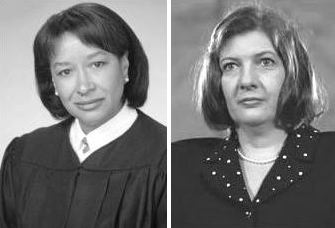
janice rogers brown & priscilla owen

Left Behind Fridays

"He turned CNN on low so it wouldn't interrupt his sleep, and he watched the world roundup before dozing off. Images from around the globe were almost more than he could take, but news was his business. He remembered the many wars and earthquakes of the last decade and the nightly coverage that was so moving. Now here was a thousand times more of the same, all on the same day. Never in history had more people been killed in one day than those who disappeared all at once. Had they been killed? Were they dead? Would they be back?"


Catch up on Fred Clark's weekly dissection of the "Worst Books Ever Written" in the Left Behind archives at Slacktivist.